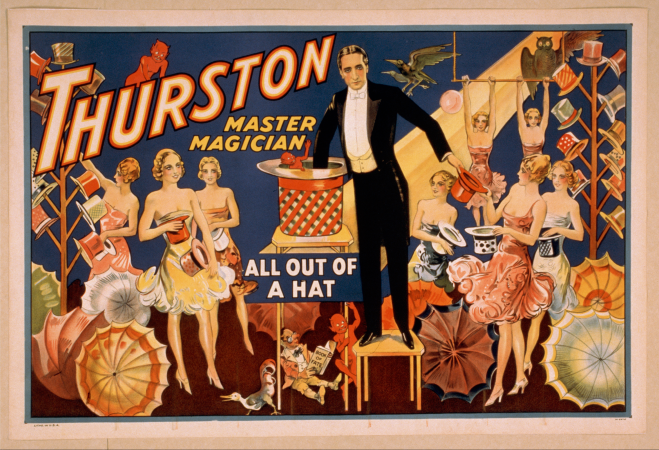
Wind projected the warrior faces printed on our dresses into films coming alive on our legs, slouched to one side like tired horses. We were waiting for the train on a “Bad-Idea” platform, miles away from our designated area, where only the plural consciousnesses live—We, the Royal Weeze. We were late and nervous, a sitting brace of ducks in Houdini territory where only the magicians were allowed to be.

We exchanged worried looks on the tea-kettling winds of the platform, souring our eyes on vivid tiles of Kar-Mi the Mysterious taming a crocodile and Vel Mar the Great swallowing swords—nothing like our drab pictotiles, the great AllOfUs holding hands with Infinity. And then over the whirring hum of our dread came footsteps. A pert click clack that could only mean a magician was coming to join us on the platform.

We cinched up our faces and puckered our eyes to…
View original post 735 more words
Share this:

Here are 10 Amazing Examples of Flash Creative Nonfiction (we’ve recently enjoyed)
Creative nonfiction or cnf is the art of truth telling. Flash cnf is the same thing at blender velocities. Here is a list of some of the best we’ve had the pleasure of reading.
1. uzodinma okehi
Pure Fantasy – Atticus Review
The kickboxing class is supposed to be my training for The Movie, though by this point it’s all become little more than pure fantasy.I can’t blame Abdul. To be honest. Put it another way, Abdul, messing around, his video camera to the Hi-8 cassettes stacked on the TV, run it through a co-axl, and I’m watching water droplets on a spiderweb, 15-minute sunsets, and so on.
In “Pure Fantasy,” Uzodinma Okehi details the death of creative inspiration. If you’ve been wondering why your dreams for artistic greatness are never realized, Okehi has a theory. It seems that the answer has something to do with the “half life effect…of Iowa City” and that insidious soul killer, Nintendo N64. We admire the way this writer plunges us into a moment with a story inside it. In just under 700 words, Okehi reveals a friendship, a collaborative vision born within it, and the slow fade of both into the dull monotony of the everyday. Okehi’s final description of the “rogue’s gallery of fools” in kickboxing is artful in its brevity, equal parts hilarity and disappointment. This is a great piece with powerful resonances beyond the “merely autobiographical.”
2. Frenci Nguyen
The point of some flash CNF seems to be the worst moment ever enshrined on the page for others to witness. It can be gruelingly confessional. Extremes cannot be passed off as fictions, as happening to nobody ever. When writers blend wisdom with confessional intensities, a textual form of justice—or at least the possibility for a full hearing opens up on the page. We feel ourselves falling vicariously into different roles of this all too familiar scene for students of color on college campuses around the United States. Other pieces we found worthy of second readings here include “Election Day” by Ashley Cowger, “Inside My Mother’s Mouth” by AM Roselli, and “Persuasion” by Ona Gritz —but be fore-flashed…though they are quick reads, they’re in no way light or easy. Pain sprints. It moves in flashes. Much slower is understanding, a lolly gag from way back who wears concrete shoes.
Read the rest here:
https://www.michaelandsarachaney.com/blog/2020/8/17/best-form-poetry
Share this:
A family story as complex as American history, tracing in part to 1820s Berlin Crossroads in Ohio
As the celebration of this country’s revolutionary independence looms, I cannot help but reflect on my own ancestry and what it says about place and race, politics and perspective. A mixed-race Ohioan, I was born in Cuyahoga Falls and raised in the Akron/Cleveland area. Like most Ohioans, I am proud of our wooded forests, our first-rate colleges, our winning sports teams. I want to believe that if more people knew about Ohio’s Black and mixed-race histories, we would be cautiously optimistic to note those times when Black lives have mattered in Ohio — in the solemn presence of mourning those times when Black lives should have mattered more.
This won’t be a linear story. As with all history, including complicated family histories, and, particularly, family trees made more complicated by the intersection of different races, it moves from Akron to Germany and back to Ohio, with some side branches that go back 200 years to a once-storied and now largely forgotten African American community in Ohio’s Appalachia.
Akron 1976: I celebrated the Fourth of July with my father. He cheered with my brother and me on the driveway with sparklers and cherry bombs. Though he looked white (more on that later), he had married a visibly mixed-race woman while serving overseas in Germany.
My mother was an “occupation baby,” born of an African American G.I. and a German woman. She grew up with brown skin in a very white Germany. She was named Angelina so as to pass as Italian, but she identified as African American. After she left my father, she brought my brother and me to Cleveland Heights, a town renowned for its interracial tolerance. It was there my brother and I spent many more Fourths of July, bottle rockets and smoke snakes.
Cleveland Heights was a mecca of mixed-race families. Fourth of July get-togethers at my grandpa’s home with my cousin Dietrick and my brother Tony, my mother and stepfather: Skin colors ranged from my own — white looking skin — to my brother and mother, to my grandfather’s very dark complexion.
My grandfather didn’t like other people’s racial assumptions. He avoided these by reminding everyone of his national identity and veteran affiliation. “I’m American,” my grandpa liked to say, as a Black man in America, with particular pride and defiance on the Fourth of July.
My father doesn’t hail from the same African American line as my grandfather, whose family line includes many more veterans, reverends, and teachers from a free Black community in Florida. By contrast, my father’s African-Americanness was hidden, perhaps like my own.
My father’s veiled Black Ohio ancestry brought me back to Columbus in the 1920s. There, in my research, I found my father’s mother, Edna, living with her father and her mother, Norma Jessie (or Daisy). Sometimes this woman was recorded as Norma Jessie Cassell or Cassells, claiming to be white. At other times, however, her last name was recorded as Carrell. It turns out, Daisy descended from a Black family living near the Berlin Crossroads, a famous African American town outside of Jackson, Ohio, in southern Ohio’s Appalachia.
Moving backwards another hundred years to 1820 Ohio, we find the Cassells (sometimes Carrells) living as a prominent African American family near the Berlin Crossroads of Jackson County. This family from whom I am descended on my father’s side (where in a perfect Cleveland story, I find out I am Black even on the White side) have established themselves in a household led by William and Rachel Cassells from Virginia. In 1820, William Cassells would have just arrived in Ohio with Rachel, who was listed on the Virginia census as his concubine and later as his wife after an official ceremony in the early 1820s.
According to historical sources, William was a slaveowner who freed Rachel and her children and brought them to Ohio. He hoped to establish them on their own land. He is said to have fought duels to defend their right to that land. William did not stay with his family in Ohio, and Rachel did not live long. The fate of her children was decided in a small probate court in Jackson County a few years later. The orphans were appointed a guardian, a white man who held their inheritance until they were old enough to receive it. The Cassell children each held 100 acres and a house in Jackson County for decades, until the Berlin Crossroads became a battle site in the Civil War and many of its homes, churches, and businesses were burnt to the ground.
It is worth noting that, thus far, White Ohioans have been more interested in the Berlin Crossroads as a Civil War battle site than as a site of Black and mixed-race Ohio heritage. This is a grave shame. The Crossroads were a rural community of free African Americans and a powerful home of the Underground Railroad and Black church.
But history is fickle. Even when remembered, it is often malformed through present-day lenses, and shaped by our expectations for a simple, unified story of a relatable past. But sometimes the past comes to us full of complexity. Instead of one story, there are two, or more. Instead of reinforcing assumptions about family resemblance, where like things (such as members of a family) are expected to look alike, the stories of the past could challenge us to live our most complex lives.
To conclude, I am reminded of a seeming contradiction in the reporting of a Fourth of July from 1855 at the Berlin Crossroads. The Jackson Standard newspaper, in one column, claims that not a sound is heard throughout the town on the Fourth of July, as if no one cared to celebrate, while another column describes parades of young schoolchildren mustered to the center of town, where they heard the Declaration read aloud and ceremonial music played.
This kind of complexity and seeming contradiction is central to history, and to my own experience as a mixed-race person (in which people often ask me to explain away that which doesn’t seem to make sense). It is like that newspaper page from 1855, complicated and multi-voiced. But it suggests what is deeply true in this case: That more than one thing can be true at the same time.
I hope to live in a world eager to tell and to share in the complex and difficult stories of the past without omitting the contradictions that make us American — and some of us, distinctively Ohioan.
(Originally published as an op-ed in the Cleveland Plain Dealer and Cleveland.com )
Share this:

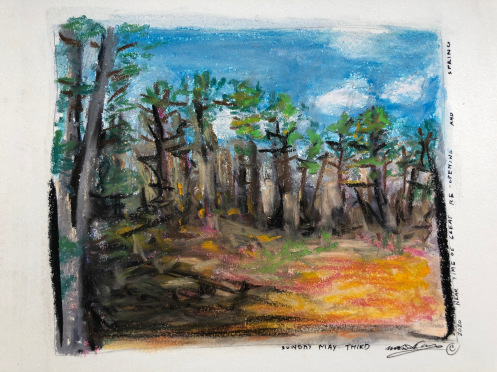
We sit at a window. One with pen. The other, pastels. We reflect. Together.
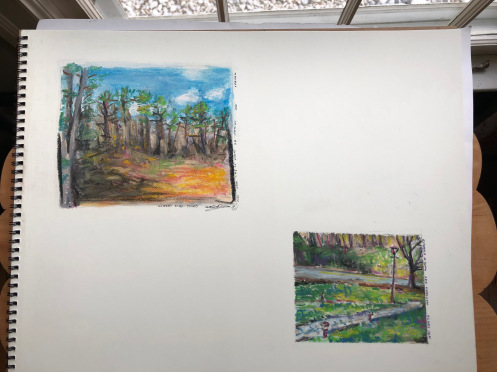
The gaps are for poems (and verbal visuals) to be added later.
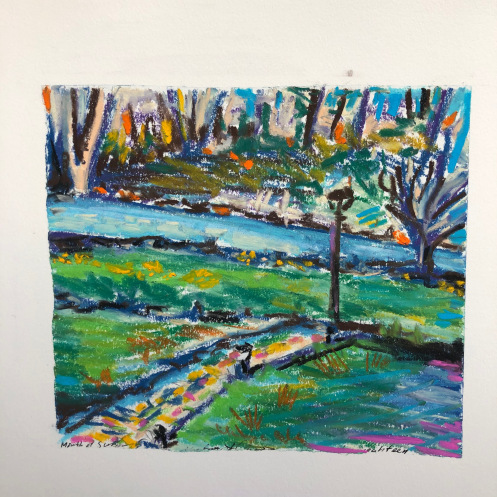
These are part of a project we call “month of sundays.” We sit together every Sunday, to look out of the same window.
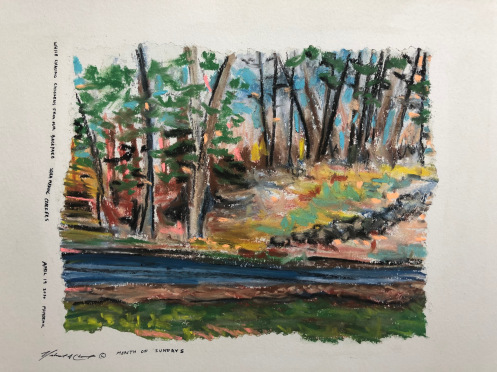
We do it for a month of Sundays or for thirty Sundays.
Having done it for some years now, we feel it has provided us with inspiration and preparation for life in times of pandemic.
Share this:


Beware the lord who asks of wolves what he would of men:
‘How dare you come here and insult me in this way?’
~ The Iron Mountain Clause
At the end of the world nothing is more precious than secrets and every Warlord is master of one: Men are singed, biting hogs in the sun. When the bellows of the hordes peel for killing, the Warlord keeps bellies warm with fire.
That is why the arrival of the Dog Prince is bittersweet. For tired guards and bone men, gaunt mechanics and skull hunters, the sight of those dogs in formation is wasps in the eyes. Columns of war brutes with nail-spiked collars. Shepherds and sight hounds sleek as night rain congeal at the Dog Prince’s side. He stands there, as usual, with that panting statue the wolfhound.
He steps down from his skeleton sled and drops a palm of rag beans to the team in harness. They eat with green eyes fixed on the Warlord’s men, a gawking ring of leathery fear armed to rotted teeth with hunger—and not just for food. Some of the men notice how far they have shrunk in the presence of all of this fanged discipline.
And yet, the arrival of the Dog Prince also bodes well—fuel cylinders wet for the taking, a finger smooth crate of hand grenades in an un-buried train. Perhaps a newly fallen bull, its flesh whispering to the nucleated morning. A vaporous feast for flies. Dreams of unknown stores to be sniffed out by a Dog Prince-for-hire. That’s what the temporary humiliation of seeing such well-fed dogs means to men. They would rather eat than bow to dogs even as they make way for them now. Those dogs, stout and fierce, their gauntleted paws slicing hot sand. The bearded wolfhound, tall and stately gray, marching dutifully behind his master to meet the Warlord on the black steps for terms.
The Warlord grunts behind a plexiglass vaporizer: “Have your dogs found food or fuel for us this time, Dog Prince?”
The Dog Prince has a winding sheet on the color of the desert. The straps beat a rhythm against his chest in the wind. Only his mouth peeks through the wrappings around his face. Goggles mute his eyes. When he speaks, it is only Babylon.
“Babylon!” screams the Dog Prince.
Whispers from the men. What? Who is that?
Again, the Dog Prince yells the name and again the Warlord is left to mime the confusion of dogs, tilting mottled horns at the oddity and adjusting his vaporizer with a snap of the side mount.
A hundred times before, the Dog Prince had come to mount the black steps and to paint his teeth with the same soot as the Warlord. They had struck the usual terms many times before but never had they howled them in this way. And men, like dogs, react to new or loud things with much flinching and some shame for having flinched. All of that thickens the leaded air of the black steps.
“What is this Babylon?” growls the Warlord after the third shout, which prompts a fourth from the Dog Prince.
This time, the Warlord notices the gesture the Dog Prince makes as he shouts. A splaying of the hand. Flesh exhaled, as if the wind should name its accuser with men’s fingers. The gesture is clearly directed at the wolfhound.
The Warlord turns to face the horselike creature whose steady black eyes make him laugh, cough, and then look away.
The Warlord’s vaporizer muffles sacred words. “Babylon be damned, Dog Puke! Have you lost your mind? You dare come here. Insult me in this way?”
The Iron Mountain clause. Shifts in the sand. Well-worn handles on makeshift crossbones and spears—the whole scene a tableau of grip and fidget, sunsear and dogswatching.
And then the Dog Prince bows as Babylon clomps forward. The dog’s black eyes hold steady behind grey whiskers that curve with his gait like tusks.
The Dog Prince speaks from his bowed position: “Babylon. New leader of the family and first in line in all things. Babylon.”
Spiders and rust in the Warlord’s vaporizer: “Am I to make terms with a dog?” Laughter from bellies used to howling. Brown teeth, yellow, and none, all showing. Black eyes watch.
Louder then from the one still bowing: “Babylon. New leader of the family…”
“Fine then,” through the Plexiglas vaporizer. “Which is it, Baby Loon, food or fuel?”
Even louder from the one still bowing: “First in line. In all things.”
“Terms. Terms.” The Warlord says while pulling the strap away from his lips for the dog to hear, and the dog hears less than it smells from the Warlord’s lips. And that is all it needs to know.
Babylon is a Minotaur indifferent to bulls and men. He is hungry only for vaporizer and bloody plexi. There are no more terms or messages to be exchanged. Each leather sleeve is an envelope in grease, posting flesh. The dogs race to read their grim letters—the arms and legs of those who only moments before had been dreaming of dog livers charred to the dunes with butter rock and smoke stick.
At the end of the world dogs come to terms better than men. This is the last secret. And it is his alone. Still bowing before the carnage, the former Dog Prince holds on to it with little concern. The places where his eyes had been scream inside his goggles, but he is still hopeful for a place in line.
A beta nips him up and so he stands. His nose turns to the sky mindful of the Western crag along the horizon. There, the salted fires of the next camp of men make eyes for the night to see us with.
Share this:

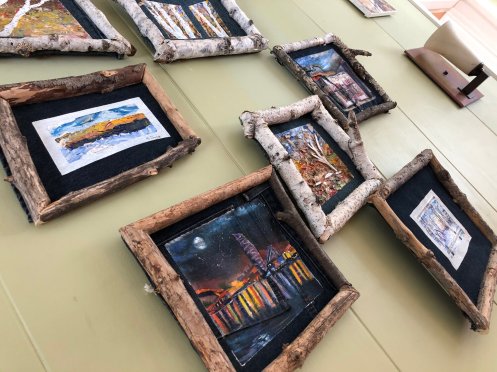
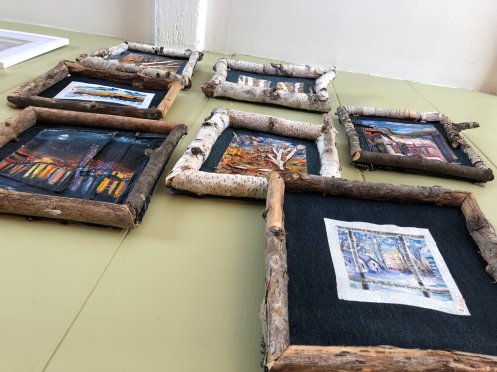
Here are ideas for frames that are more artful than they are limiting.
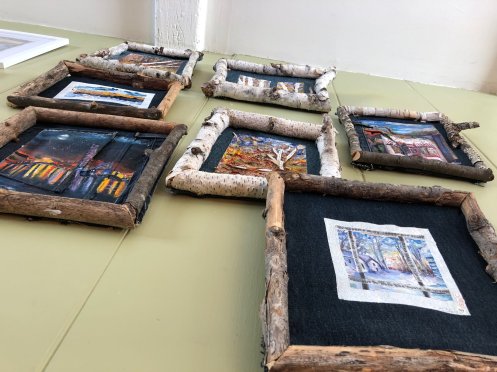
Art looks best when framed. But what is a frame? An ideal border, a frame proposes those parts of an artwork which are deemed, more or less, central. By the fact of the frame being a limiting device, art pushes somewhat against the concept of a frame. Art, like the American poet Walt Whitman, wants to kick down the doors, opening up to the world. Frames say, the art stops here. Art doesn’t want to talk about endings or edges in such simple terms.
With such different intentions and outlooks, It’s strange that art and frames would ever get along at all.
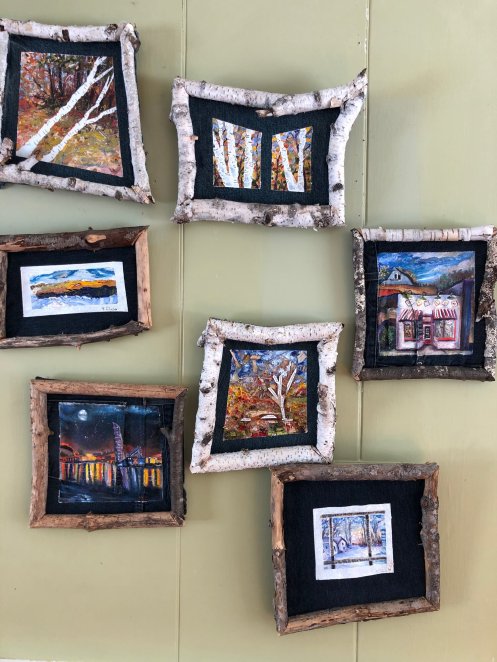
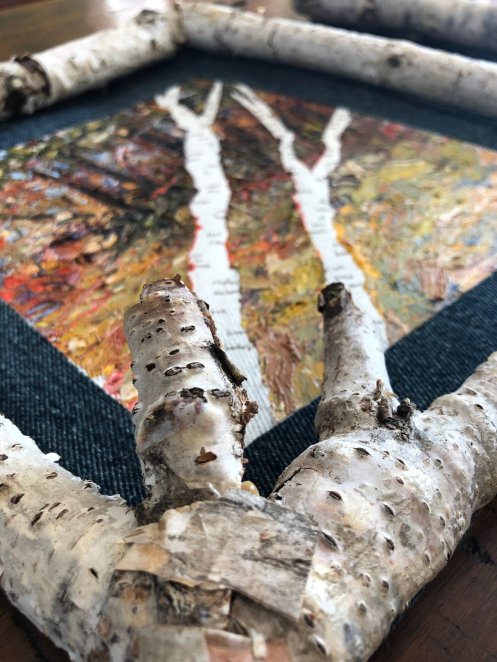
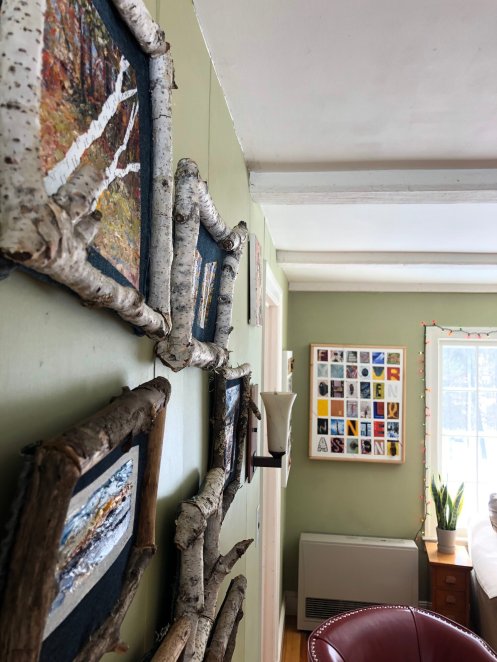
We prefer frames and grounds, which are the surfaces an artist paints on. that agree with art. These artworks are original landscapes. Some are visual poems as well as paintings. The natural materials express freedom of form, both the organic world and its impending limits. The frame co-creates the effect of the view. This is what a frame ought to do.
Share this:


We are thrilled to have our collage published in the form of a small e-book. Admirers can have a copy of the poem that is also a collage, a graphic narrative, and a fairy tale about a woman finding her voice.
Partly published in Redivider and the New Delta Review, originals were exhibited in juried art shows:
Gender in the Balance, August – September 2019 Barrett Art Center, Poughkeepsie NY
The North by Northwest (NXNW) Exhibition July – October 2019. Yellowstone Art Museum, Billings, MT
Get your e-book here:
Share this:

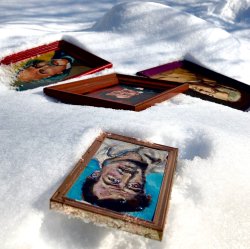
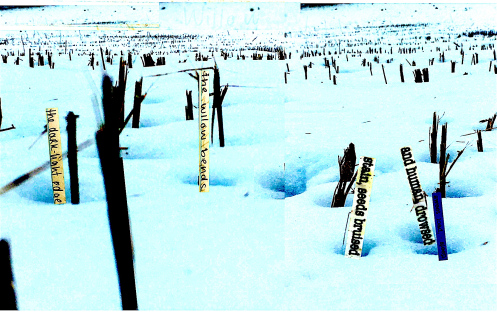
Winter is especially inspiring for the artful and art-minded. Absence of chroma leaves room for the mind to imagine colors impossible to see in June.
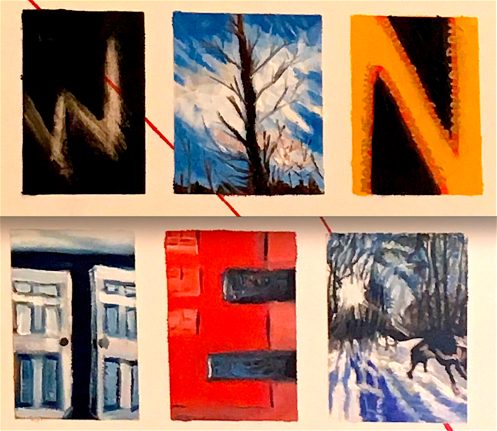
We spend winter looking for view. Pardon the bacon, by the way, the blueberries don’t mind. We’ll hike through our backyard with Vegas in tow, looking for sights as we crunch through the snow.
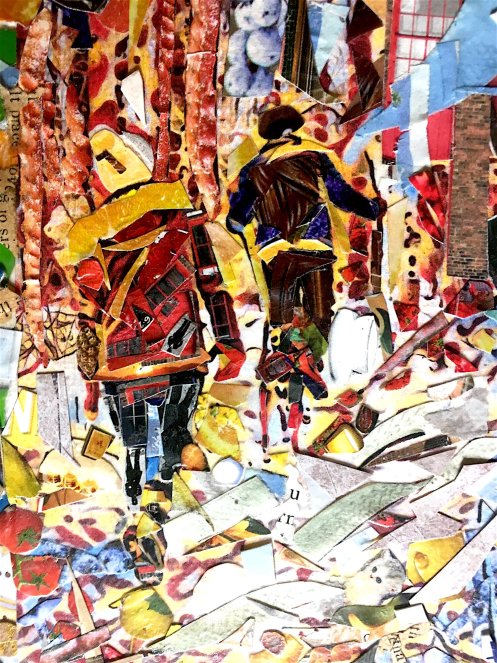
Sara pauses to see a poem.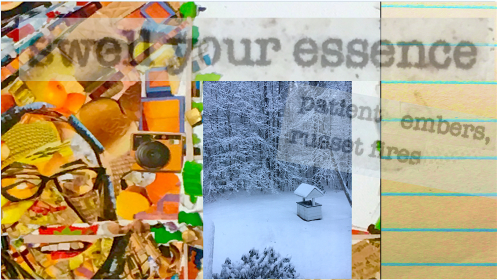
And then Vegas smells another volume of poetry in the willows.
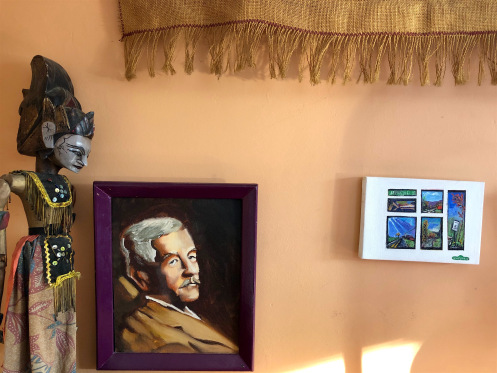
Back inside, we sit with books. Faulkner is there. But we keep a close eye on him.
Hemingway is there too. He is orange inside a stuffy old house in winter. Though mini, this Hem has a big head for outside adventures.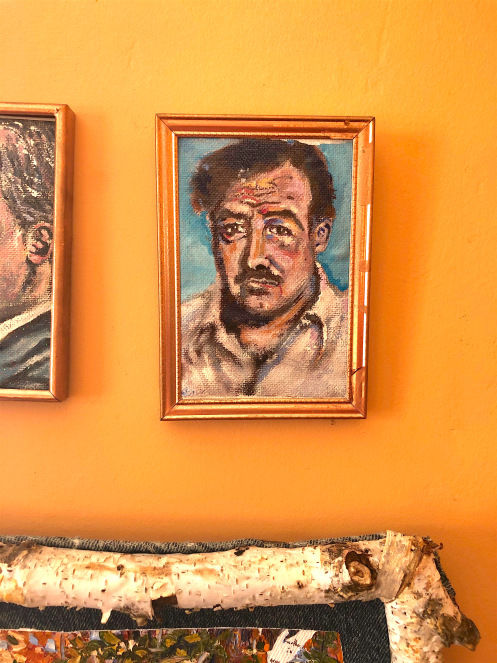
Uh-oh, mini Hem establishes himself against forbears and compeers alike. Harry Bloom, who wrote all the diagnostics on this kind of conflict, would thank Oedipus for Hem’s aggression in the snowball fight that ensued. 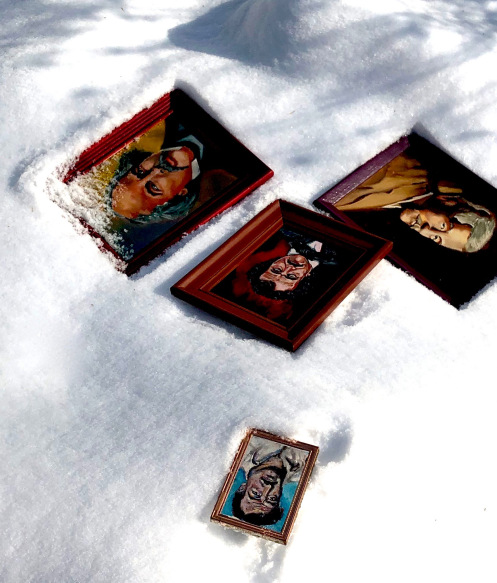
Take that Hawthorne!
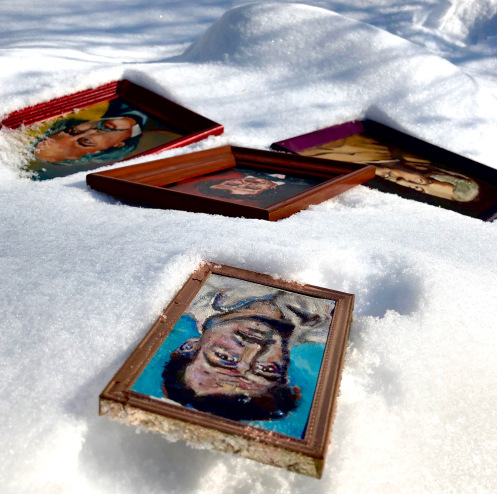
Here he is, King of the Mountain. 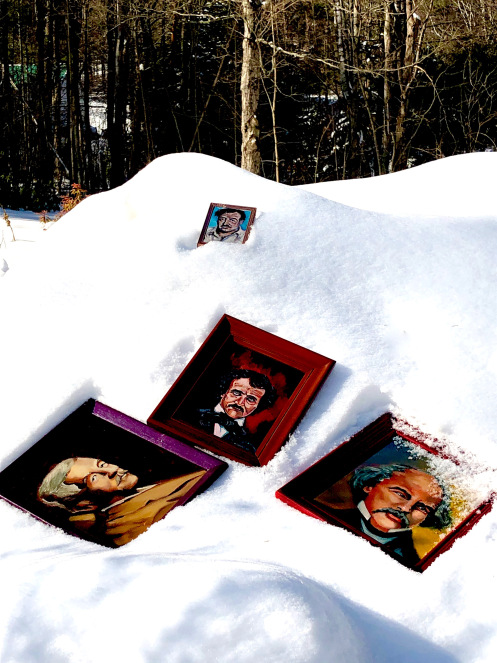
We’re not sure we can keep this one on our wall for long. Perhaps, you’d fare better. If you’d like to have your own adventures with one of these roguish authors, apply here.
https://www.etsy.com/shop/MichaelChaneyArt
and don’t forget to follow us on Twitter @Mrmaxchi Michael Chaney Art
Share this:

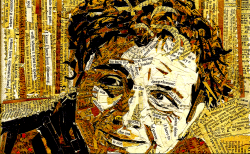
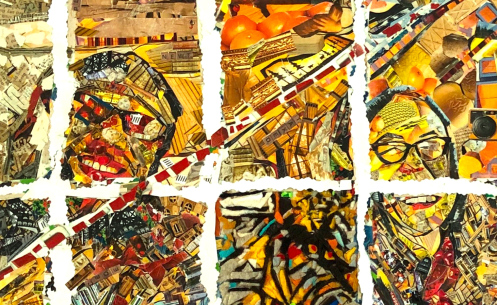
Sara Biggs Chaney and I have been busily working with papery word fragments, piecing them together, layer upon layer, until greeting a face.
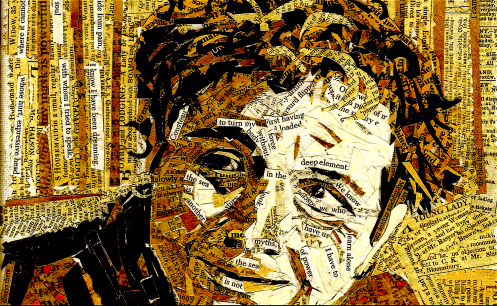
Adrienne Rich
Adrienne Rich, Gwendolyn Brooks, Lucille Clifton, Elizabeth Bishop, and HD. These are poets we admire. Their words forge textures on the page. Each one is an 8×10 artwork collage ready to brighten any room. The beauty of words and faces, of fragments and figures, shines through the glue in each portrait.
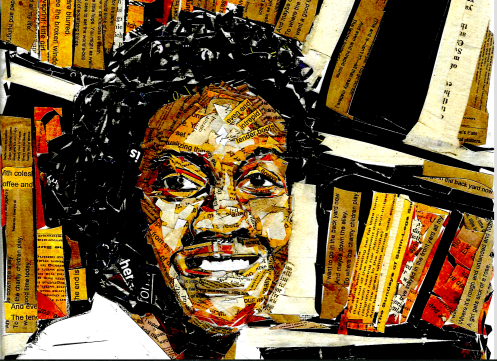
Gwendolyn Brooks
You’ll notice how the titles of the books in the re-worked photo above are comprised of more lines from Brooks’ poetry…. And by the way, for now, our favorite adhesive is liquitex matte glaze.
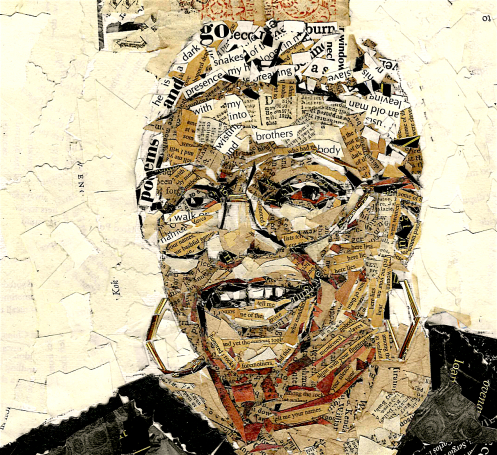
Lucille Clifton
There are stiffer papers used in the Clifton collage above. Collage challenges the camera and our eyes to see things normally perceived through touch–like contour, edge, weight.
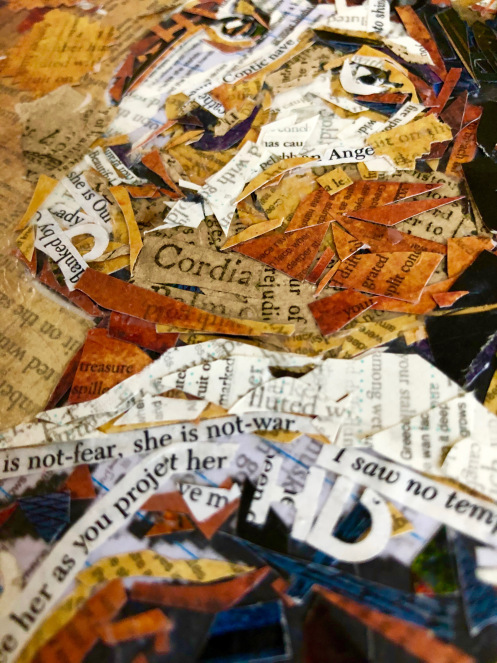
HD
We selected our subjects for the force of their original poetry. And we wanted to memorialize great poets.
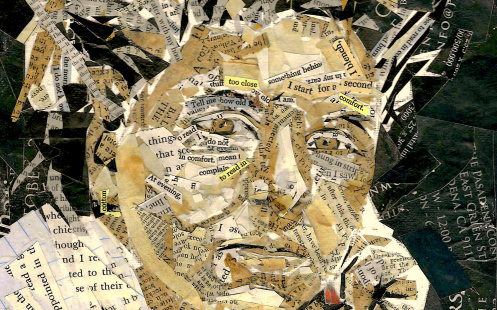
Elizabeth Bishop
We prefer mod podge and home made mixtures for other projects, but these were perfect for the matte glaze. The paper and words are the focus of these portraits.
We hope you like them.
Michael and Sara
To purchase one of these portraits or to see more, visit the shop
https://www.etsy.com/shop/MichaelChaneyArt
Share this:

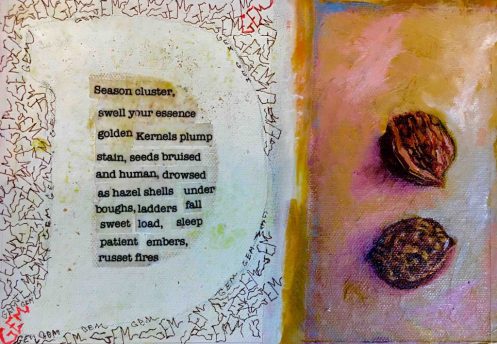
We are pleased to have a visual poem up at Florida Review online or Aquifier with Sara Biggs Chaney
 Season Cluster floridareview.cah.ucf.edu/article/season